For New York dispensaries · Built on the Metrc third-party API
Know your shelf matches Metrc before the state asks.
Smoke Alarm reads your point of sale and Metrc, compares them with what is physically on the shelf, package by package, and turns every difference into a case with an owner and an evidence trail. Receiving, counts, findings and fixes, on one record.
Works beside the point of sale you already run: Dutchie, Flowhub, Treez, Blaze, Cova or BioTrack. Prefer to watch? The 61-second tour
Built on the Metrc third-party API · New York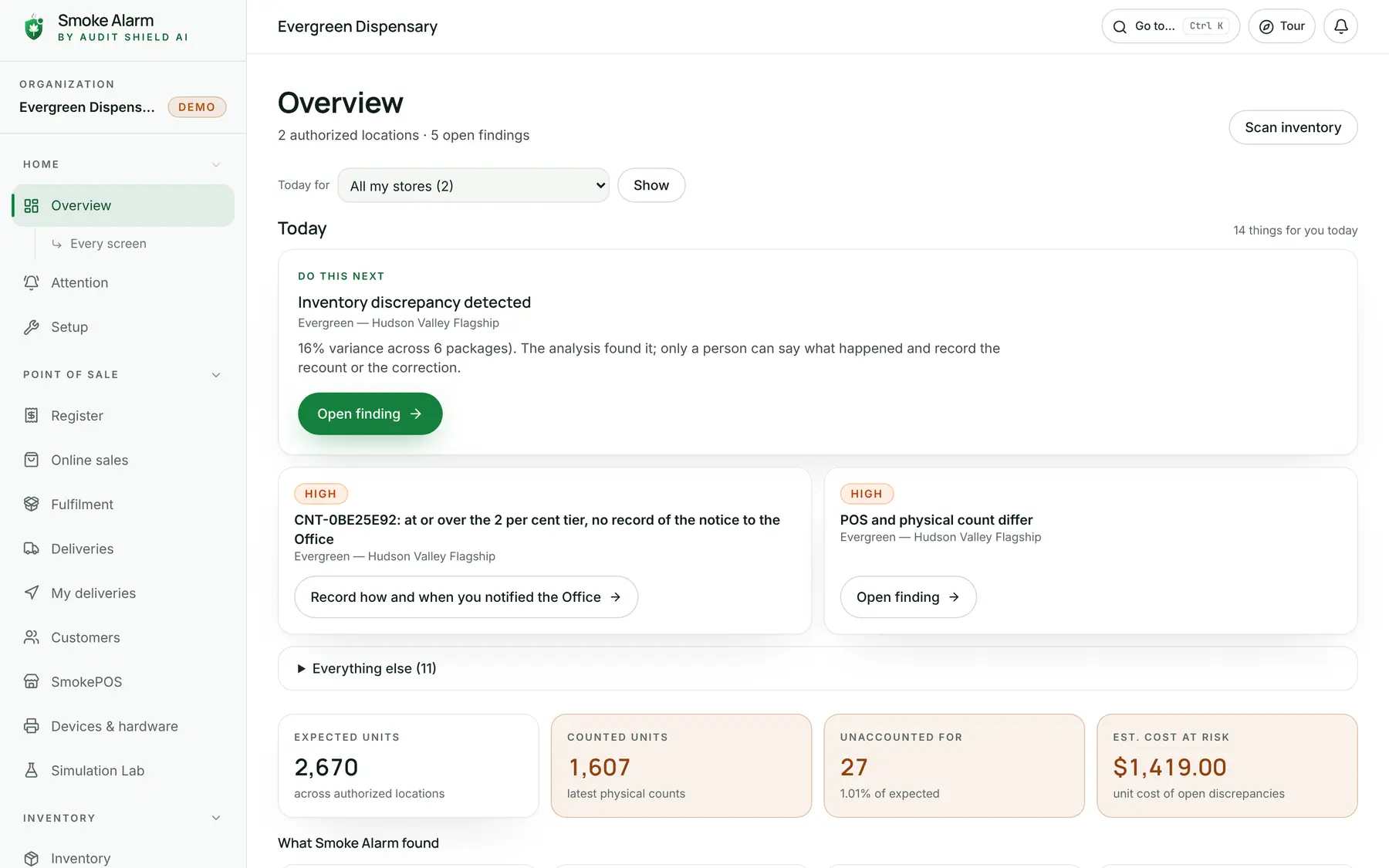
Built and supported from the Finger Lakes, for New York licensees.
Reads the state system of record through an authorised connection.
Serving three active customers in the Rochester area.
A minority- and service-disabled veteran-owned business.
Receiving, reconciliation and the fix, on one record.
Three places a dispensary loses track of a package, and what Smoke Alarm does at each. The screens are the product, from a sample store.
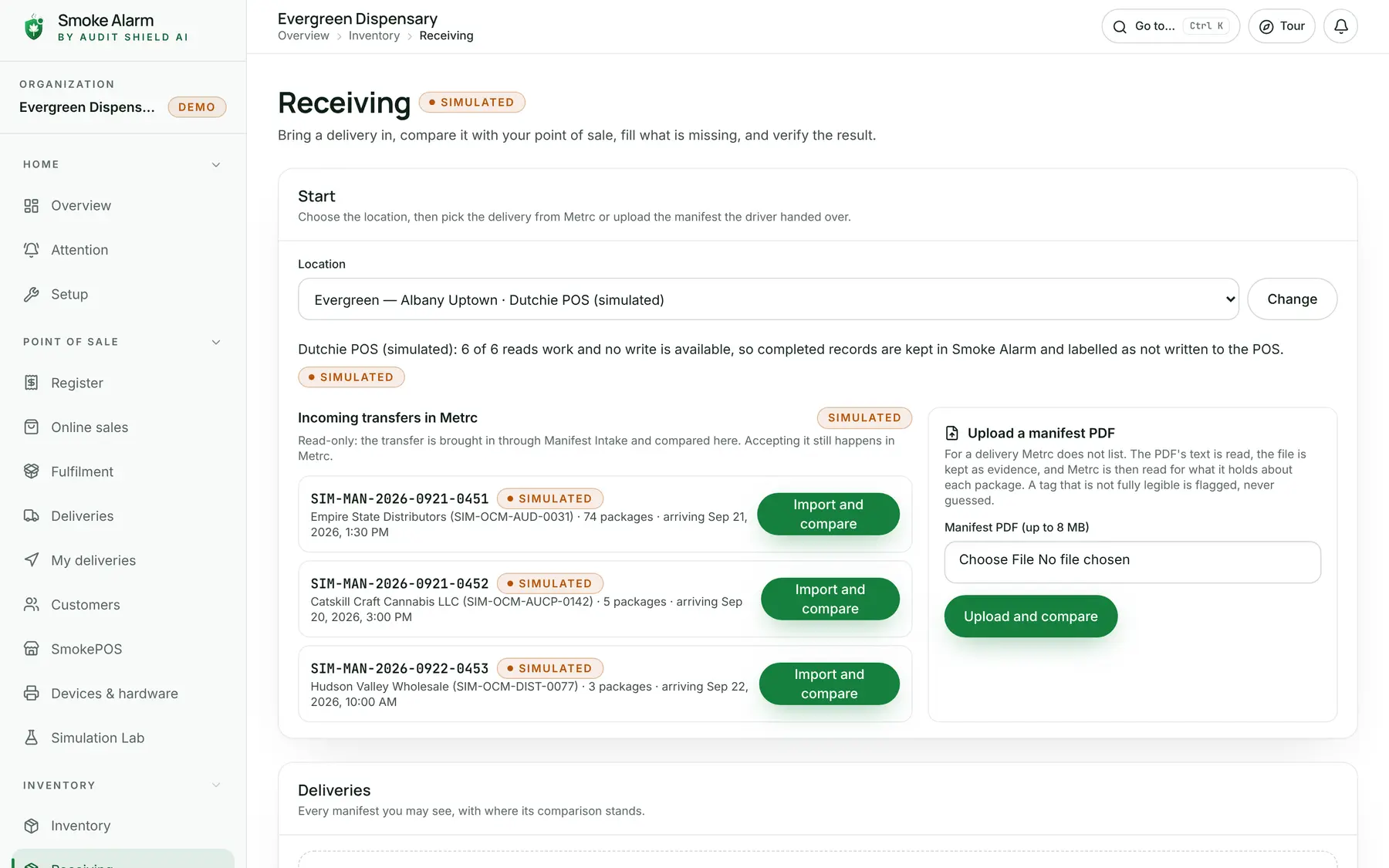
Receive against the manifest, not the invoice.
Bring the Metrc transfer in or upload the manifest the driver handed over, check each package at the dock, and let the short, extra or wrong ones become cases before they reach the shelf.
- Metrc transfers and manifest PDFs, read and matched package by package
- Every package tied to its tag and its lab record
- Exceptions kept with who, when and what, for the supplier conversation
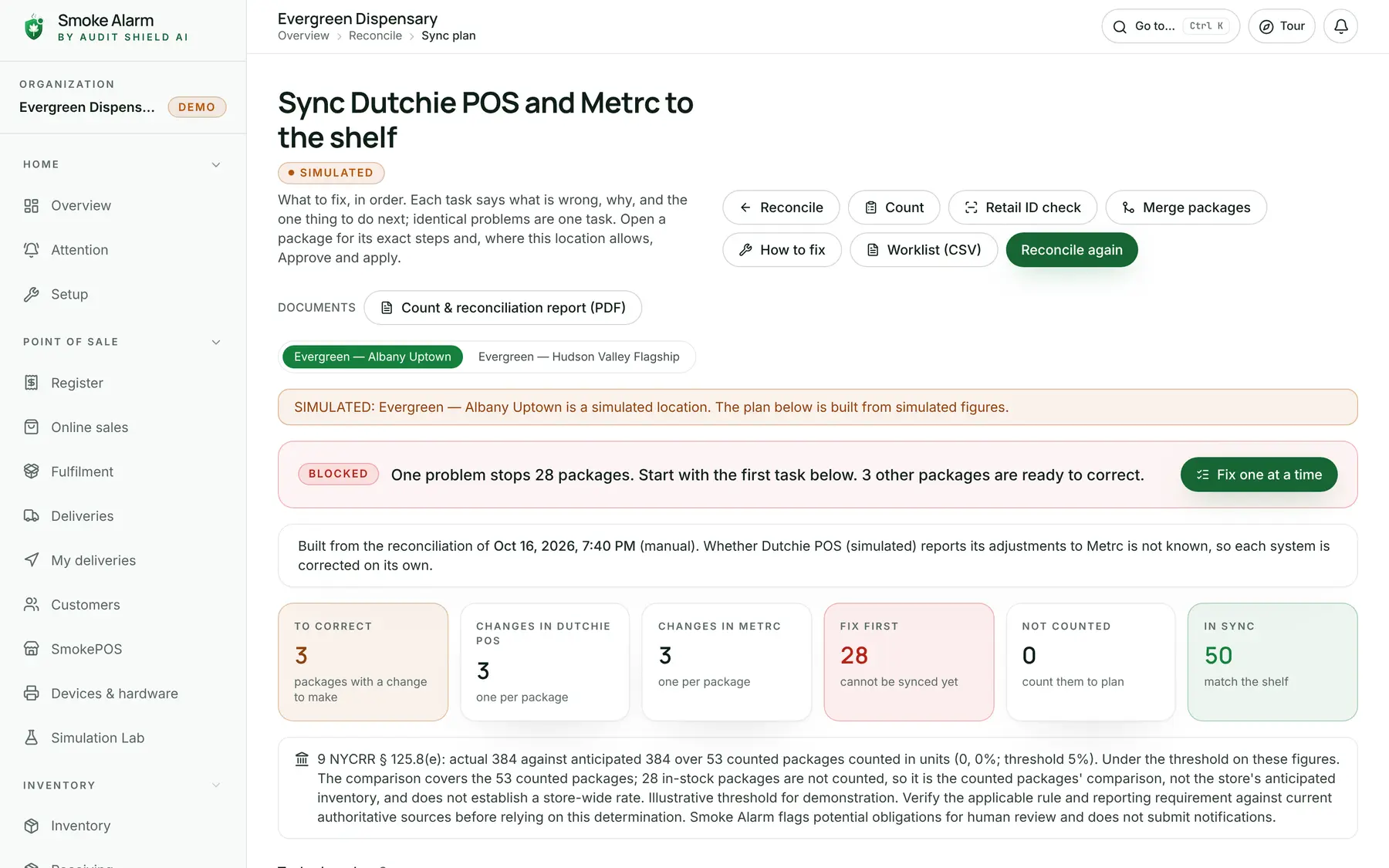
Reconcile Metrc, your POS and the shelf, package by package.
Every hour, and after every count, Smoke Alarm compares the three and writes down exactly what to correct, in which system, in what order. The threshold is read from the regulation, not guessed.
- A sync plan with one route per package and the blockers named
- Counts, scans and point-of-sale exports in one place
- The report an inspector asks for, as a PDF, from the same record
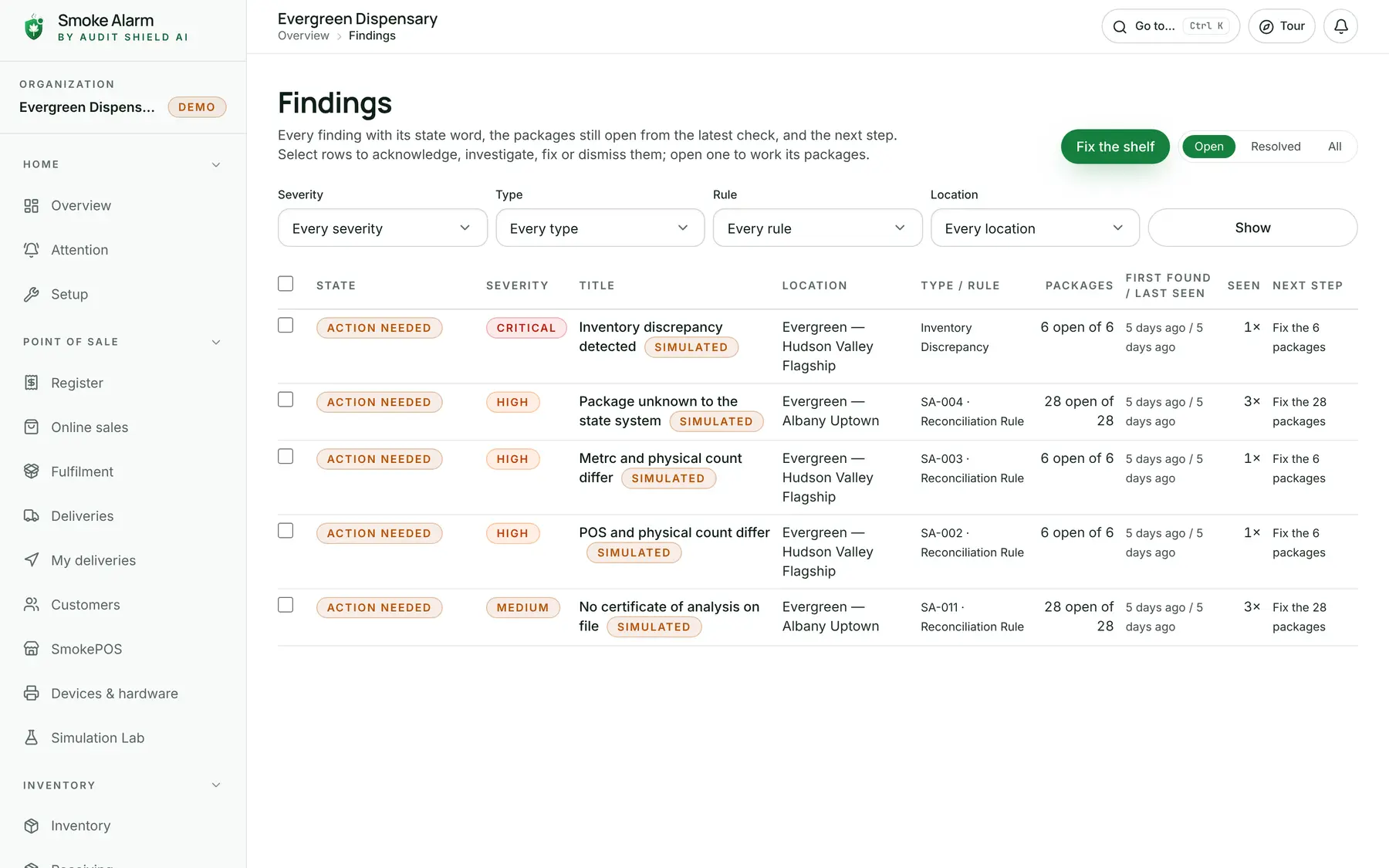
Fix it with an audit trail an inspector can follow.
Each finding is one issue, stated once, with its packages and the sources compared. A manager approves each correction, the batch is authorised, and every write is checked by read-back. The record stays.
- Findings, cases, recounts and corrections on one timeline
- Approve one at a time; authorise the lot; see each write verified
- Nothing changes in Metrc or your POS without a person's approval
Connected in a day. A rhythm by the end of the week.
No rip-and-replace. Reconcile works beside the point of sale you have; the Smoke Alarm POS is there when you want one record from the register too.
- 01
Connect
Your point of sale by connector or by export, and each location's own Metrc user key, stored encrypted and tested before anything goes live.
- 02
First reconciliation
Within the first day: every package compared across Metrc, the POS and your last count, and a plan for every location that names what to fix first.
- 03
A weekly rhythm
Counts on a schedule, findings worked as cases, the daily report in your inbox, and the team on the phone when a question comes up.
Priced per location. Written down.
Audit Shield Reconcile is the way most stores start: it reads Metrc and your POS and never writes to either. The full price list, the Smoke Alarm POS and the one-time audit are on the pricing page.
Reconcile Micro
Daily reconciliation for a very low-volume or microbusiness store.
$99
per location a month
Reconcile Pro
Most chosenContinuous manifest and inventory reconciliation beside your POS.
$399
per location a month
Reconcile Enterprise
Every location reconciled and resolved from one place.
From $799
per location a month
Smoke Alarm POS carries no base subscription: a per-transaction Compliance Technology Fee, disclosed on the pricing page.
Built close to the work, in Rochester.
Audit Shield AI is a minority- and service-disabled veteran-owned business with Rochester, New York roots. Serving 3 active customers in the Rochester area.

Charles Underwood
Co-Founder & CEO
Charles leads Audit Shield AI's commercial strategy and industry relationships, keeping product development anchored to the real operating challenges faced by cannabis businesses.

Ken Clark
Co-Founder | Technology & Operations
Ken leads Audit Shield AI's product architecture, AI systems and operational automation.
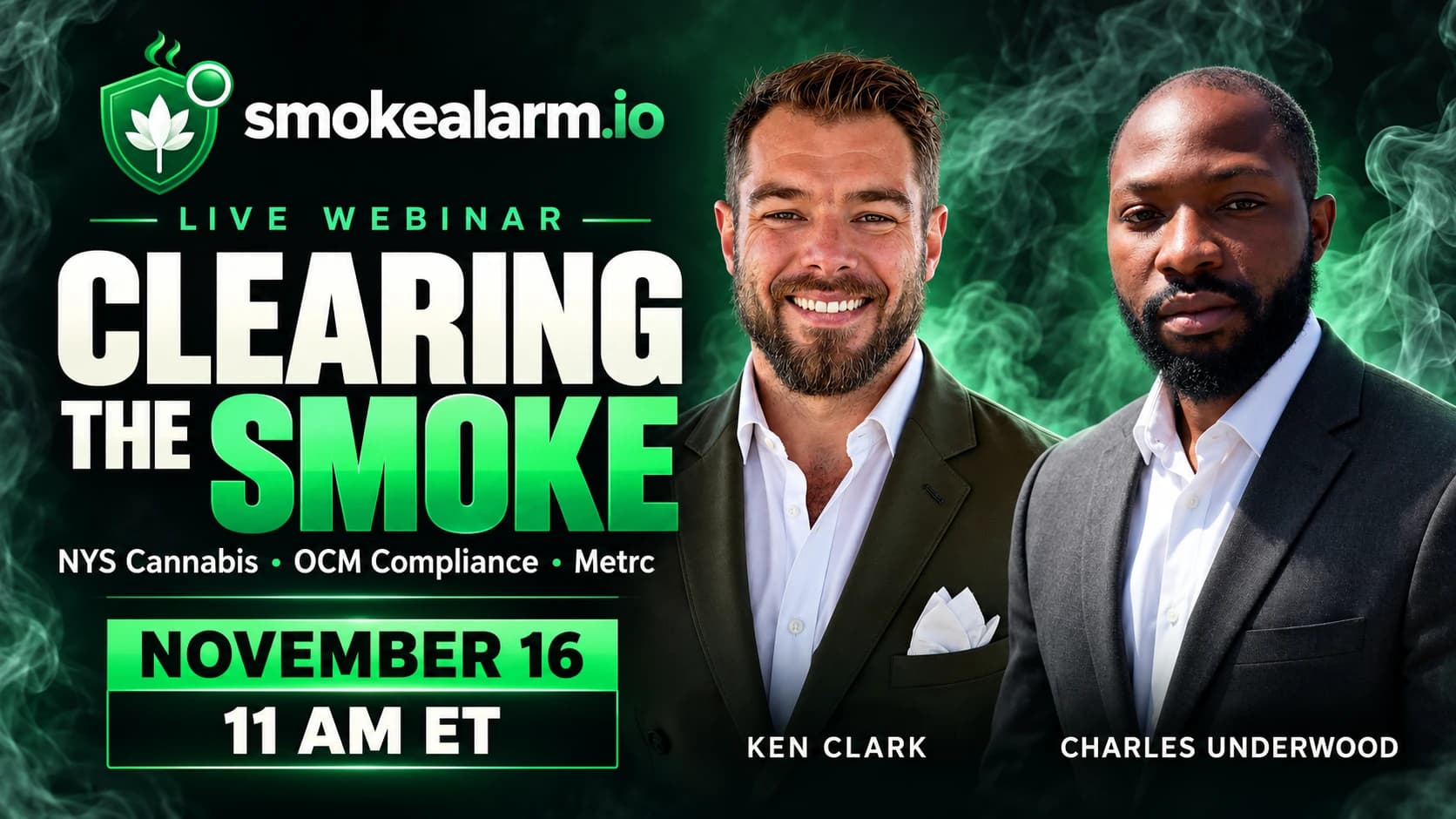
Live webinar · smokealarm.io
Clearing the Smoke
November 1611 AM ET
- NYS Cannabis
- OCM Compliance
- Metrc
What New York's Office of Cannabis Management expects your records to prove, where Metrc and the shelf drift apart, and how to find and fix the gap before an inspector does.
Ken Clark and Charles Underwood host it live. About an hour, with questions.
Free. The join link and the recording go to the list; every email has an unsubscribe link.
YOUR TIME. YOUR NUMBERS.
What could a smoother
workday be worth?
Less time chasing paperwork means more capacity for your team. Build an estimate from the work you do today.
Make it your estimate.
Monthly figures · editable example assumptions
ILLUSTRATIVE ESTIMATE / PER MONTH
Room to do more.
Estimated labor value, less the added software cost you entered.
5.25 hoursof estimated monthly team capacity recovered
- Current task time
- 21 h
- Projected task time
- 15.75 h
- Current labor cost
- $672.00
- Projected labor cost
- $504.00
- Labor value recovered
- $168.00
- Added software cost
- $0.00
- Projected total cost
- $504.00
An estimate, not a promise. Recovered time is team capacity, not guaranteed payroll savings. No avoided fines, guaranteed compliance or customer results are included.
Connect your dispensarySee the formula and assumptions
Current hours = (deliveries × minutes per delivery + separate reviews × minutes per review) ÷ 60.
Recovered hours = current hours × assumed reduction ÷ 100. Projected hours = current hours − recovered hours.
Net monthly estimate = recovered hours × loaded hourly labor cost − added monthly software cost. Projected total = projected labor cost + added software cost.
All volumes are monthly. Count each task once; do not include receiving work again in inventory review. Existing software costs are excluded from both sides. Only the added cost is deducted. Training, setup costs, taxes on software, overtime and changes in staffing are excluded. Defaults are an editable example, not observed performance.
Volumes accept whole counts from 0–100,000; task times 0–1,440 minutes; hourly cost $0–$10,000; assumed reduction 0–100%; added software cost $0–$10,000,000.
Plain answers.
- What does Smoke Alarm actually do?
- It watches inventory for licensed dispensaries. Every hour it pulls what your POS, your state tracking system and your own counts say is on hand, reconciles them package by package, and raises a finding when they disagree. It then guides your team through investigating and documenting the discrepancy.
- Does Smoke Alarm replace Metrc?
- No. Metrc (or your state's tracking system) remains the system of record. Smoke Alarm reads from it through an authorised connection and compares it with your POS and physical counts. It never writes to Metrc except through a correction your team has approved, and until your credentials are connected it runs on a clearly labelled simulated connection.
- How does this protect my license?
- Regulators care about unexplained inventory. Smoke Alarm finds shortages early, flags when a discrepancy crosses a regulatory threshold for your team to review, and keeps a complete, timestamped record of how each one was investigated and resolved. That record is what an inspector asks for.
- How do I see it working with my dispensary?
- Connect your dispensary: create your account, add your locations, choose your POS, then either import your current inventory from a CSV export or load the sample dispensary, which carries a real 27-unit shortage (2.16%) you can investigate end to end.
See it on your own numbers.
Twenty minutes with Ken and Charles: bring one manifest and one register close, and we will show you what Smoke Alarm finds.